
External force applied to an elastic material generates stress, which subsequently generates deformation in the material. At this time, the length of the material L extends to L+ΔL if the applied force is a tensile force. The ratio of Δ L to L, that is Δ L/L, is called strain. On the other hand, if a compressive force is applied, the length L is reduced to L−ΔL. Strain at this time is (−ΔL/L).
The electric resistance of a metal change proportionally to the mechanical deformation caused by an external force applied to the metal. By bonding a thin metal to a measurement object through a thin electrical insulator, the metal deforms depending on deformation of the measurement object and its electric resistance changes. The strain gauge (electric resistance strain gauge) is a sensor to measure the strain by means of measuring the resistance change. A strain gauge is constructed by forming a grid made of fine electric resistance wire or photographically etched metallic resistance foil on an electrical insulation base (backing), and attaching gauge leads.
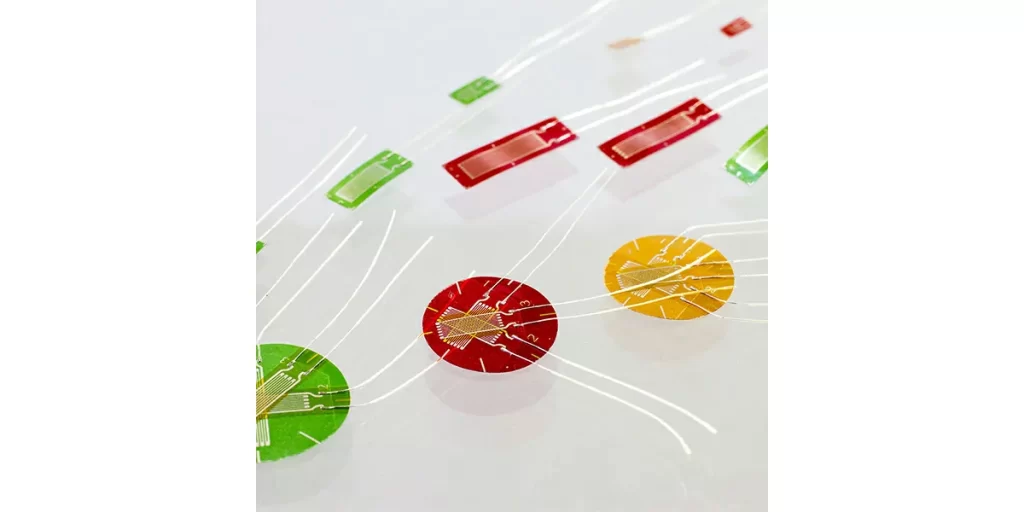
Strain gauges are generally used for one of three reasons:
using strain gauges due to their superior measurement characteristics.
When strain is generated in a measurement object, the strain is transferred to the resistance wire or foil of the strain gauge via the gauge base (backing). As a result, the wire or foil experiences a resistance change.
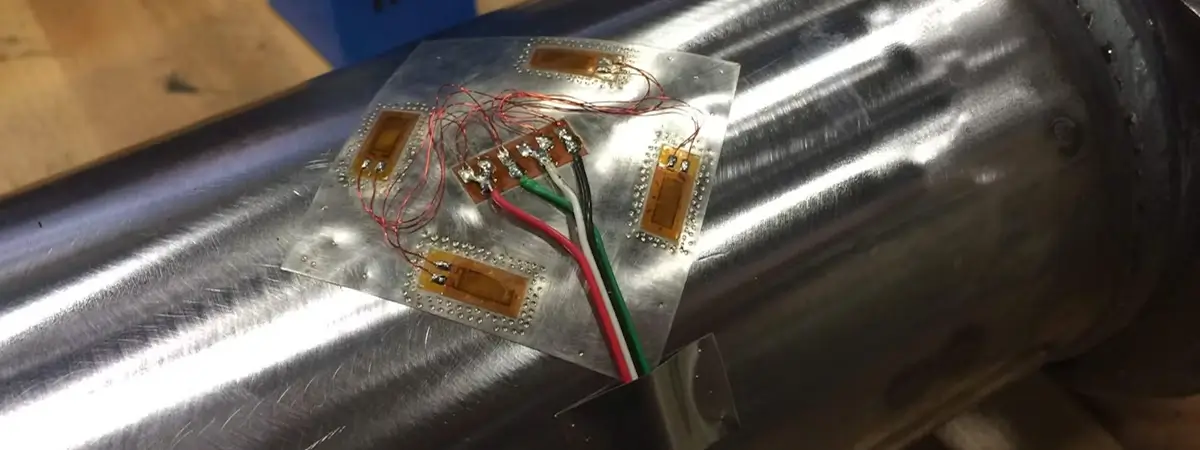
Strain gauges have a wide range of applications, including the measurement of force, pressure, and torque in industries like automotive, aerospace, and biomedical engineering. They are also used in structural health monitoring for bridges and buildings, material testing to analyse stress and strain, and in various industrial and consumer products like weighing scales.
Widely used in tensile, compression, vibration, and fatigue testing to study material properties under different conditions.
Structural Health Monitoring (SHM): Used to monitor the integrity of structures like bridges and buildings by detecting stress and strain, which helps in preventing failure.
Monitors the deformation of soil, rock, and underground structures like tunnels and retaining walls to assess stability.
Industrial applications
Automotive and aerospace
Vehicle testing: Used in crash simulations, brake testing, and vehicle emission testing. Aerospace: Applied in aircraft and missile production to monitor strain on components. Rotating equipment: Measures torque in applications like generators and propeller shafts.
Biomedical and consumer products
Biomedical equipment: Integrated into surgical tables, dental chairs, and MRI equipment for patient monitoring. Prosthetics: Used in prosthetic legs to sense usage mode and adjust settings. Consumer electronics: Found in products like smart phones and bathroom scales.