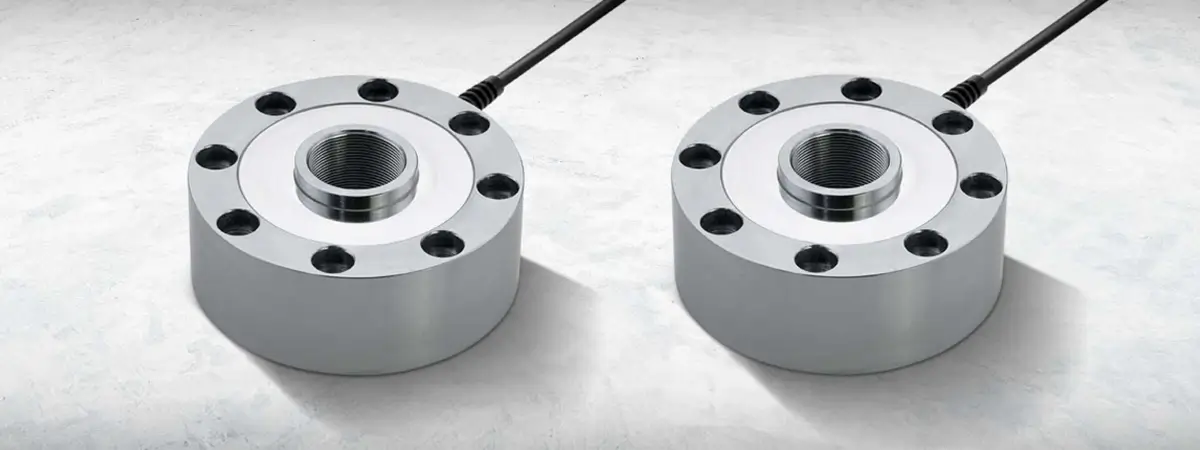
Load cells are used to convert force and load to electrical signals. The detecting element for force and load is a strain gauge that TML developed especially for load cells. With our extensive field-proven record and experience applied to structures and materials in all load cell areas, our cells have earned widespread trust as high precision products offering excellent consistency and durability. Our line includes a number of compression, tension and tension/compression universal models with high to low capacities. Since our load cells are so widely used, we also offer all types of products related to load cells that allow customers to choose exactly what they need for their particular purpose. In addition to load cells, we also carry a line of products for measuring torque, such as torque transducers for socket wrenches, etc.
Categories of load cell:
Load cells can be categorized by their operating principle (like strain gauge, hydraulic, or pneumatic) or by their physical design (like single point, S-type, or canister). Strain gauge load cells are the most common, but hydraulic, pneumatic, and capacitive cells also exist, each with different designs for specific applications.
By operating principle:
- Strain Gauge: The most common type, these convert force-induced deformation into an electrical signal by measuring changes in electrical resistance. Strain gauge load cells are further divided into many sub-types based on their physical design.
- Hydraulic: Use a hydraulic fluid and piston to measure force. The weight of an object on the load platform is balanced by the pressure of the liquid, which is measured by a gauge.
- Pneumatic: Similar to hydraulic cells, but they use compressed air or gas instead of fluid. An elastic diaphragm and pressure gauge measure the air pressure needed to balance the load.
- Capacitive: Measure force by detecting changes in capacitance, which occurs when the distance between plates in a capacitor changes under stress.
- Piezoelectric: Utilize the piezoelectric effect, where certain materials generate an electric charge in response to mechanical stress.
By physical design
- Single Point: Used in small to medium platform scales and are designed to handle loads from a single point of application.
- Canister: Cylindrical-shaped load cells for high-capacity compression measurements. The force is applied vertically through a central sensing section.
- Bending Beam: Measure force by placing a weight on a single beam, causing it to bend. They are used in applications like pallet and platform scales.
- Shear Beam: Measure force applied in a direction perpendicular to the beam’s main axis. They are common in both low-profile and heavy-duty applications.
- S-Type: A type of bending beam load cell, often used for tension applications. The “S” shape allows for both tension and compression measurements.
- Compression: Specifically designed to measure downward, compressive forces. They are often used in heavy-duty applications like weighbridges and tank scales.
- Load Pin: Used for measuring forces in applications like hoisting and rigging, where the load pin replaces a traditional pin in a system.
Application of load cells across industries:
Load cells have a wide range of applications across industries, from weighing and process monitoring to structural integrity and safety. They are used in manufacturing for quality control, in logistics for vehicle weighing, and in healthcare for medical devices. Other key applications include structural testing in construction, force measurement in automotive and aerospace testing, and accurate filling and packaging in various sectors.
Automotive and aerospace:
- Testing: Measuring forces during crash, suspension, and brake testing to ensure safety and durability.
- Structural analysis: Monitoring forces and pressures on aircraft components and structural analysis in aerospace.
- On-board weighing: Integrated into vehicles for applications like weighing cargo.
Construction and infrastructure:
- Structural testing: Assessing the load-bearing capacity of bridges, buildings, and other structures.
- Anchor monitoring: Measuring forces in rock bolts, tiebacks, and foundation anchors.
- Load monitoring: Used in cranes and hoists to prevent overload and ensure safety during lifting.
Manufacturing and logistics:
- Process control: Monitoring forces in hydraulic presses and controlling the filling weight in packaging machines.
- Quality control: Ensuring accurate weight measurements for product quality and batch processing.
- Weighing systems: Used in tank and silo weighing, conveyor belt systems, and truck weighbridges.
- Medical devices: Used in patient lifts, hospital beds, and infusion pumps to ensure patient safety.
- Rehabilitation: Integrated into exercise and rehabilitation equipment to monitor forces.
- Testing and research: Providing accurate measurements in research, testing, and procedural operations.
- Agriculture: Integrated into machinery like grain silos and livestock scales to measure weight.
- Robotics: Essential components in robotics and automation for force and pressure measurement in robotic arms and grippers.
- Energy: Used in wind turbines, power plants, and for monitoring tension in transmission lines.
- Marine and offshore: Measuring forces in marine structures, offshore platforms, and mooring systems.