Overview
In modern engineering, accurate strain measurement is the foundation of structural integrity, safety certification, and product reliability. While laboratory testing has its place, many of the most critical structures and machines simply cannot be brought into a lab — bridges, dams, pressure vessels, wind turbines, mining equipment, and large industrial installations must be measured exactly where they live and work.
This is where on-site strain gauging services become essential. By bringing certified engineers, calibrated equipment, and field-grade strain gauges directly to the asset, on-site strain gauging delivers real-world data under real operating conditions — something no lab simulation can fully replicate. At Proact IMS, we have helped industries across India unlock the value of in-field strain measurement, and the benefits speak for themselves.
What Is On-Site Strain Gauging?
On-site strain gauging is the process of installing, wiring, and measuring strain gauges directly on a structure or component at its actual operating location — rather than in a controlled lab environment. The service typically includes surface preparation, gauge bonding, lead-wire routing, signal conditioning, data acquisition setup, and live measurement under actual load conditions.
A typical on-site strain gauging service involves:
- Surface preparation of the test location
- Bonding strain gauges using application-specific adhesives
- Routing and shielding lead wires to minimise noise
- Connecting to a portable data acquisition system
- Live measurement during operation, load testing, or proof testing
- Data analysis and reporting for engineering decisions
Because the measurement happens in the actual operating environment, the data captured is far more representative of real-world performance.
Why On-Site Strain Gauging Matters
Modern industrial structures are designed using simulations and finite element analysis (FEA), but no model can perfectly predict the behaviour of a real asset under actual operating loads, temperatures, and environmental conditions. Manufacturing tolerances, installation variances, ageing, and dynamic loads all influence how a structure behaves in service.
On-site strain gauging closes this gap by providing measured, validated, real-world data — enabling engineers to:
- Validate FEA and design assumptions
- Certify structures for safe operation
- Diagnose unexpected failures or fatigue cracks
- Extend the service life of critical assets
- Justify maintenance and inspection schedules
Without on-site measurement, critical engineering decisions are often made on assumptions rather than facts.
Key Benefits of On-Site Strain Gauging Services
1. Accurate Real-World Data
The most significant benefit of on-site strain gauging is measurement under actual operating conditions. Lab simulations approximate real loads, but field measurements capture the true combined effect of static loads, dynamic forces, thermal gradients, vibration, and environmental influences — giving engineers data they can fully trust.
2. No Asset Downtime or Dismantling
Bringing a large structure — such as a crane, bridge, or pressure vessel — into a laboratory is rarely practical and often impossible. On-site strain gauging eliminates the need for dismantling, transportation, and reassembly, saving significant time, cost, and operational disruption.
3. Expert Installation by Trained Engineers
Strain gauge installation is a precision craft. Bonding errors, poor surface preparation, or incorrect wiring can introduce errors of 10–20% or more. Professional on-site services bring certified field engineers who follow strict bonding protocols, ensuring measurement integrity from the very first reading.
4. Reduced Project Risk and Liability
For load testing, structural certification, and warranty validation, on-site strain gauging provides legally defensible, third-party-validated measurement data. This reduces project risk, supports regulatory compliance, and protects asset owners from liability disputes.
5. Faster Decision-Making
With portable DAQ systems and real-time data display, engineers can see strain values as load is applied — enabling immediate decisions during proof tests, shutdowns, or commissioning. There is no waiting for lab reports days or weeks later.
6. Custom Solutions for Unique Challenges
Every structure is different. On-site strain gauging services bring application-specific expertise — including high-temperature gauges for engines, weldable gauges for steel structures, embedment gauges for concrete, and waterproof gauges for submerged or marine applications.
7. Validation of Design and Simulation Models
Field strain measurements provide the ground-truth data needed to validate or refine FEA models. This is invaluable for new product development, structural redesigns, and life-extension studies of ageing infrastructure.
8. Early Detection of Fatigue and Failure
Long-term on-site monitoring can detect fatigue, creep, crack initiation, and structural anomalies long before catastrophic failure occurs. This is especially valuable for critical assets such as bridges, dams, pressure vessels, and offshore structures.
9. Cost-Effective for Complex Assets
While on-site services may seem premium-priced, they are far more economical than the alternative — disassembling a large structure, transporting it to a lab, testing, and reassembling. For most heavy industrial assets, on-site is the only viable option.
10. Support for Predictive Maintenance Programs
On-site strain data feeds directly into predictive maintenance and condition monitoring programs, helping plant operators schedule interventions based on actual wear and stress rather than fixed time intervals — extending asset life and reducing unplanned downtime.
The On-Site Strain Gauging Process
A professional on-site strain gauging service follows a structured methodology:
Step 1: Application Study and Site Survey
Engineers review the asset, expected load conditions, environment, and measurement objectives to plan the right gauge type, location, and quantity.
Step 2: Surface Preparation
The bonding location is cleaned, ground, and chemically prepared to ensure the gauge bonds securely without surface contamination.
Step 3: Gauge Selection and Bonding
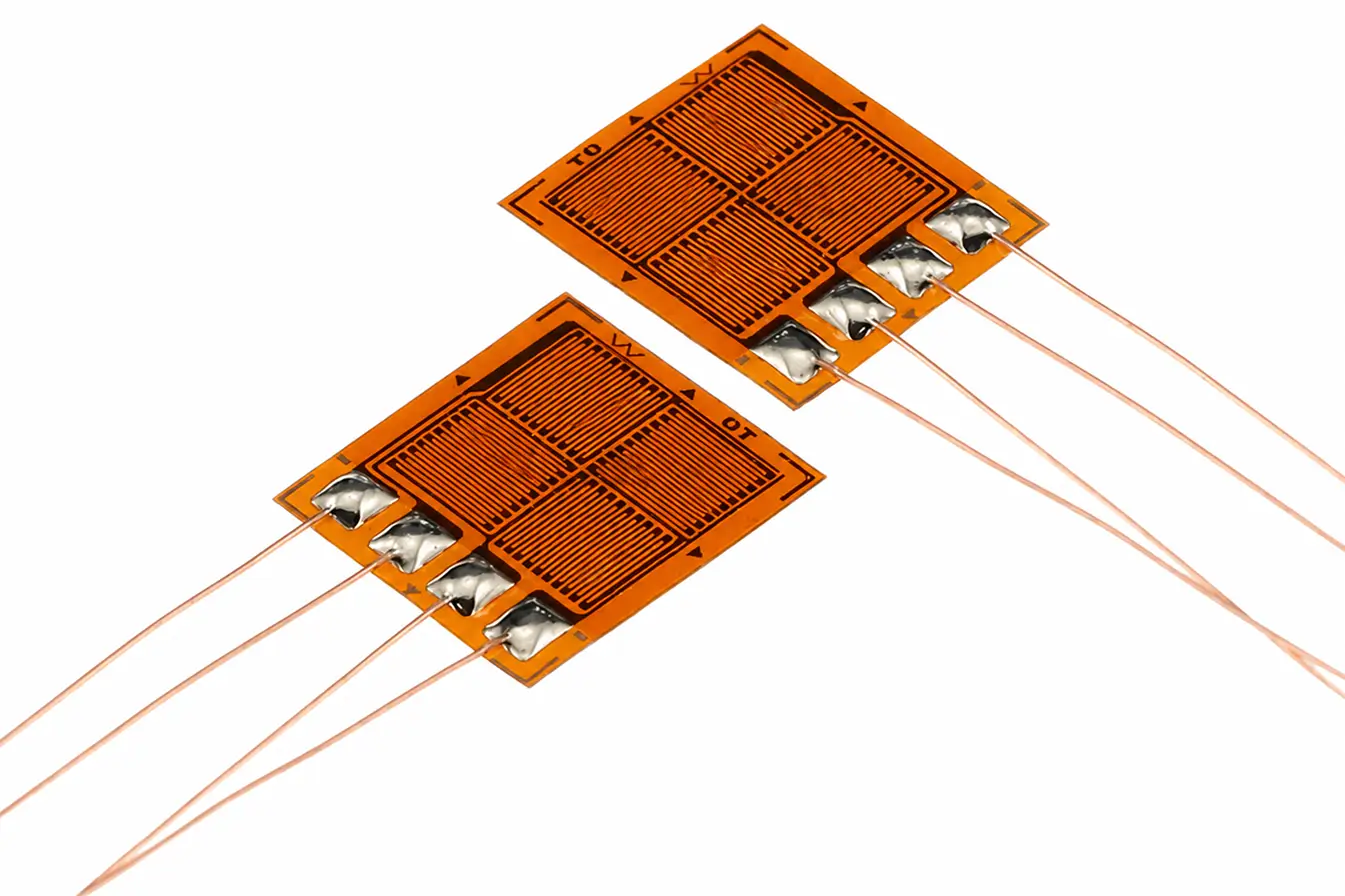
The right strain gauge — foil, weldable, high-temperature, waterproof, or rosette — is selected and bonded using application-specific adhesive.
Step 4: Wiring and Bridge Configuration
Lead wires are soldered, shielded, and routed to a junction box. Quarter, half, or full Wheatstone bridge configurations are wired based on measurement needs.
Step 5: Protective Coating
The installed gauge is coated to protect it from moisture, oil, abrasion, and environmental damage — ensuring long-term reliability.
Step 6: DAQ Setup and Calibration
A portable data acquisition system is connected, calibrated, and zeroed before measurement begins.
Step 7: Live Measurement
Strain is recorded in real time during proof loading, operation, or extended monitoring periods.
Step 8: Data Analysis and Reporting
Captured data is processed, analysed, and presented in a comprehensive report with engineering recommendations.
Industries That Rely on On-Site Strain Gauging
On-site strain gauging is used wherever real-world structural data is critical:
- Civil Infrastructure – Bridges, dams, tunnels, and high-rise buildings
- Oil & Gas – Pipelines, pressure vessels, offshore platforms, and storage tanks
- Power & Energy – Turbines, boilers, transmission towers, and wind turbine towers
- Aerospace – Ground tests of fuselages, wings, and landing gear
- Defence – Armoured vehicles, naval structures, and missile launchers
- Heavy Industry & Manufacturing – Cranes, presses, rolling mills, and process equipment
- Mining – Draglines, conveyors, haul trucks, and structural supports
- Marine – Ship hulls, propeller shafts, and offshore rigs
- Railways – Bogies, wagons, axles, and rail track monitoring
- Automotive – On-vehicle measurement during durability and proving-ground testing
Real-World Applications
The practical impact of on-site strain gauging becomes clear in everyday engineering scenarios:
Bridge load testing — Before a new bridge is opened, on-site strain gauges are bonded to critical girders and a controlled test load (usually loaded trucks) is applied. The measured strain validates the structural design and certifies the bridge for public use.
Crane and lifting equipment certification — Cranes used in heavy lifting are periodically subjected to proof load tests. On-site strain gauging on the boom and structural members confirms the crane operates within safe limits and complies with regulatory requirements.
Pressure vessel and pipeline monitoring — Strain gauges installed on critical pipeline supports and pressure vessel walls help detect fatigue, vibration, and overload conditions in oil, gas, and process industries.
Wind turbine tower monitoring — Long-term strain monitoring of the tower base and foundation helps detect fatigue and ensures safe operation over the turbine’s 20-year service life.
Heavy machinery troubleshooting — When unexpected fatigue cracks appear in excavators, mining equipment, or rolling-mill rolls, on-site strain measurement helps engineers identify the root cause — often revealing dynamic loads that design simulations missed.
Aerospace ground testing — Before flight certification, aircraft components undergo extensive ground load testing with hundreds of strain gauges installed on-site at the test facility.
Why Choose Proact IMS for On-Site Strain Gauging
Proact IMS brings together everything required for a successful on-site strain gauging project — equipment, expertise, and execution capability under one roof:
- 25+ years of field experience across automotive, aerospace, civil, defence, and heavy industry
- Trained, certified field engineers with strict bonding and wiring protocols
- Wide portfolio of strain gauges — foil, weldable, high-temperature, cryogenic, waterproof, embedment, and rosette types
- Portable, multi-channel DAQ systems for static, dynamic, and long-term monitoring
- Pan-India service network with rapid mobilisation across cities and remote sites
- End-to-end project handling — from site survey to final report
- Calibration certificates and traceable measurement standards
- 50+ on-site projects successfully executed for leading Indian organisations
Whether the project involves a single bridge load test or a long-term monitoring deployment across an industrial facility, our engineering team handles every detail — so customers get reliable data and actionable insights, not just numbers.
Conclusion
Choosing the right strain gauge is not a one-size-fits-all decision. It requires careful consideration of the physical quantity being measured, the material and geometry of the test object, the operating environment, the measurement duration, and the required accuracy. From gauge length and grid material to bridge configuration and adhesive compatibility — every detail matters.
At Proact IMS, our instrumentation specialists have extensive experience specifying, installing, and calibrating strain gauge systems across industries including oil and gas, power generation, heavy manufacturing, and civil infrastructure. Whether you are setting up a one-off stress analysis test or a permanent structural monitoring system, our team ensures you get the measurement solution that fits your application precisely.