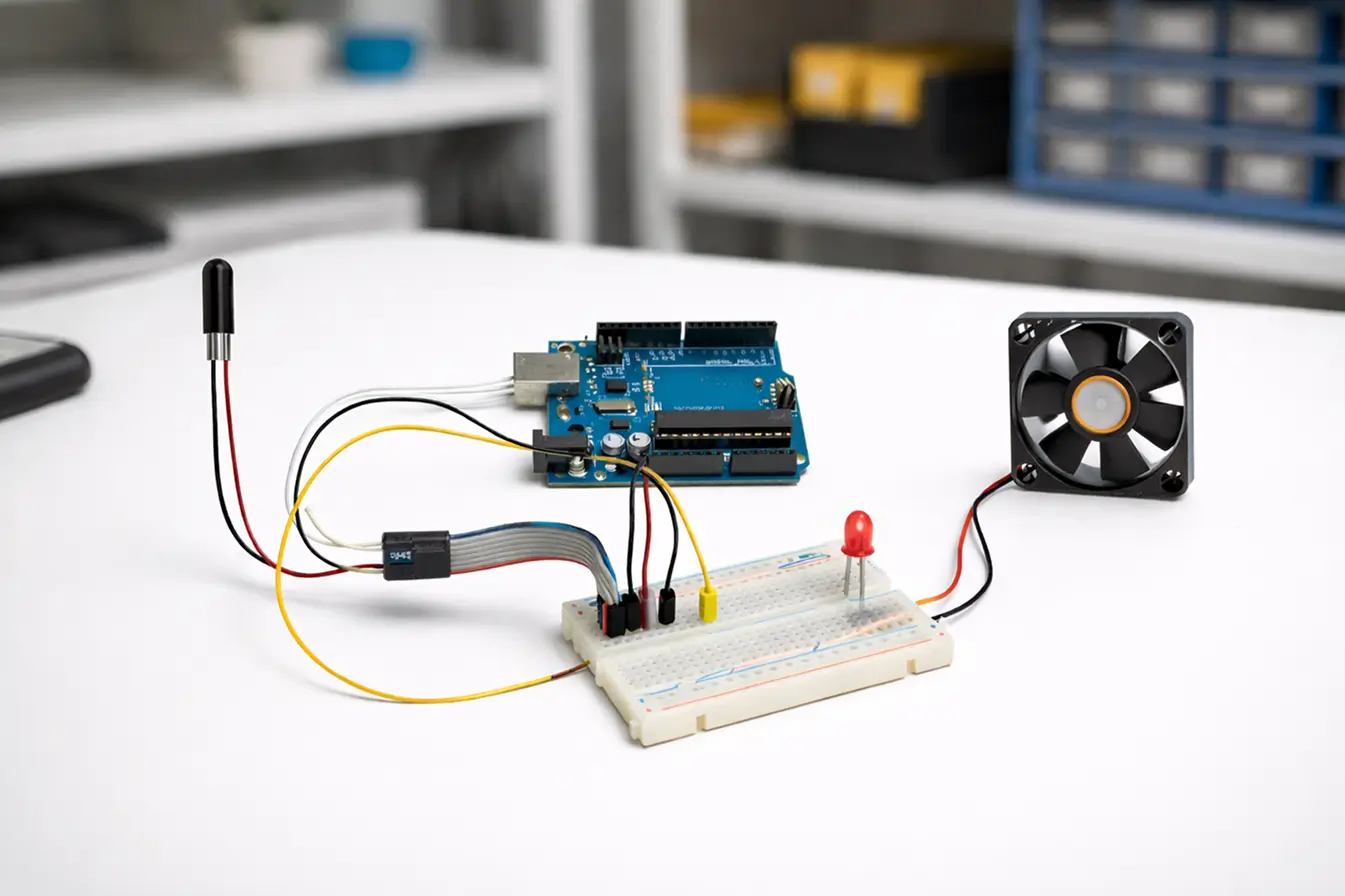
In the world of industrial monitoring and automation, the terms “sensor” and “transducer” are often used interchangeably — but they are not the same thing. Understanding the distinction is crucial for engineers, technicians, and anyone working in condition monitoring or predictive maintenance. At Proact IMS, we help industries deploy the right measurement solutions, and that starts with clarity on the fundamentals.
What Is a Sensor?
A sensor is a device that detects or measures a physical quantity — such as temperature, pressure, vibration, light, or humidity — from the surrounding environment. The sensor responds to a stimulus and produces a corresponding electrical signal (usually an analog or digital output) that can be read, interpreted, or processed.
In simple terms, a sensor acts as the “perception organ” of a measurement system. It senses what is happening in the physical world and communicates it in a form that electronic systems can understand.
What Is a Transducer?
A transducer is a broader device that converts one form of energy into another. Every transducer has two key functions: sensing a physical quantity and converting it into another form of energy — typically an electrical signal — for further processing.
Importantly, all sensors are transducers, but not all transducers are sensors. A transducer may convert energy in both directions (input and output), whereas a sensor only receives an input signal and reports it.
Types of Sensors Used in Industrial Monitoring
Temperature Sensors
Thermocouples, RTDs (PT100/PT1000), and infrared sensors measure the thermal state of rotating equipment and electrical systems. They are key indicators of overheating and potential failure.
Vibration Sensors (Accelerometers)
These detect changes in velocity and acceleration on rotating machinery. They are a cornerstone of Proact IMS’s condition monitoring solutions, helping identify imbalance, misalignment, bearing wear, and resonance.
Proximity and Displacement Sensors
Eddy current and capacitive sensors measure the position or gap between rotating shafts and stationary parts. They are used extensively in turbomachinery and high-speed shaft monitoring.
Pressure Sensors
Used in hydraulic and pneumatic systems, pressure sensors monitor fluid dynamics and help detect leaks, blockages, or abnormal operating conditions.
Types of Transducers Used in Industry
Transducers are energy-converting devices that underpin everything from measurement to actuation:
Piezoelectric Transducers
These generate an electrical charge in response to mechanical stress. Widely used in vibration analysis and ultrasonic testing, piezoelectric transducers are highly sensitive and fast-responding.
Electromagnetic Transducers
Used in microphones, speakers, and magnetic flow meters, they convert electromagnetic energy to mechanical or electrical forms. Linear Variable Differential Transformers (LVDTs) are a prime example in industrial displacement measurement.
Acoustic Emission Transducers
These detect stress waves generated by material deformation or crack propagation. They are particularly useful in structural health monitoring and early crack detection.
How Sensors and Transducers Work Together
In most modern industrial monitoring systems, sensors and transducers are integral parts of the same measurement chain. A transducer typically forms the front-end component — converting physical energy into an electrical signal — while downstream electronics (signal conditioners, data acquisition systems, and software platforms) process, analyze, and display the data.
At Proact IMS, our integrated monitoring systems combine precision transducers and smart sensors with advanced analytics, ensuring that data collected from the field translates into actionable maintenance intelligence.
Real-World Applications
Understanding the difference between sensors and transducers becomes practically relevant when designing or maintaining industrial monitoring systems:
Wind turbines use accelerometers (sensors) to detect vibration and strain gauge transducers to measure structural loads.
Rotating machinery in oil and gas plants relies on eddy current displacement sensors for shaft monitoring alongside piezoelectric transducers for high-frequency vibration analysis.
Compressors and pumps use temperature sensors, pressure sensors, and flow transducers simultaneously to give a full-picture health assessment.
Why the Distinction Matters for Industrial Monitoring
Choosing the right device for the right application is the foundation of reliable monitoring. Selecting a sensor when a transducer is needed — or vice versa — can lead to inaccurate data, system incompatibility, or missed fault indicators.
Proact IMS’s engineering team helps clients specify the correct measurement devices based on the physical parameters being monitored, the frequency range of interest, the required accuracy, and the environmental conditions of the installation. This technical precision is what separates effective predictive maintenance from guesswork.
Conclusion
While sensors and transducers are closely related, they are not interchangeable concepts. A sensor detects a physical quantity and outputs a signal; a transducer converts energy from one form to another — with sensors being a specialized subset of transducers. Understanding this distinction empowers engineers to make better design and maintenance decisions.
At Proact IMS, we bring decades of expertise in deploying sensors and transducers across industrial environments — from oil and gas to power generation and manufacturing. Whether you are building a new condition monitoring system or upgrading an existing one, our team is here to guide you toward the right solution.