
Table Of Contents
Load cells are precision measurement devices designed to convert force or weight into an electrical signal. They are widely used in weighing systems, industrial automation, material testing, manufacturing, and process control. While load cells are built to perform reliably in demanding environments, temperature changes can significantly affect load cell performance and measurement accuracy.
Temperature variations can influence the electrical resistance of strain gauges, the elasticity of the load cell’s sensing element, the zero balance, and the overall output signal. Understanding these effects is essential when selecting, installing, calibrating, and maintaining load cells for industrial applications.
A load cell typically uses strain gauges bonded to an elastic sensing element. When a force is applied, the sensing element deforms slightly, causing a change in the resistance of the strain gauges. This resistance change is converted into an electrical output proportional to the applied load.
Temperature can affect this process in several ways.
One of the most common effects of temperature variation is zero balance shift.
Zero balance refers to the electrical output of a load cell when no load is applied. Ideally, this output should remain stable regardless of environmental conditions. However, changes in temperature can cause slight dimensional and electrical changes within the load cell.
For example, if a load cell is calibrated at room temperature and subsequently exposed to a much colder or hotter environment, its zero output may change. This can result in a small reading even when there is no load on the sensor.
For applications requiring high precision, temperature-related zero shifts can become significant and may require temperature compensation or periodic recalibration.
Temperature can also affect load cell sensitivity.
Sensitivity describes how much the load cell’s electrical output changes for a given amount of applied force. Temperature changes can alter the mechanical properties of the sensing element and the electrical characteristics of the strain gauges.
As a result, the same physical load may produce slightly different electrical outputs at different temperatures.
For example, a load cell that produces a particular output at 25°C may produce a slightly different output when operating at 50°C. If the application requires highly accurate measurements, this change must be considered during system design.
Strain gauges are sensitive not only to mechanical strain but also to temperature.
Their electrical resistance changes as temperature changes. Because load cells rely on precise resistance measurements, this temperature-induced resistance change can influence the output signal.
Modern load cells often use carefully selected strain gauges and compensation techniques to reduce these effects. However, no practical measurement system is completely immune to temperature.
The materials used in a load cell can expand when heated and contract when cooled.
Different materials may have different coefficients of thermal expansion. If the sensing element, strain gauges, adhesives, and other components respond differently to temperature changes, small mechanical stresses can develop within the load cell.
These stresses can affect the strain measurement and contribute to measurement errors.
This is particularly important in applications where load cells experience rapid or large temperature fluctuations.
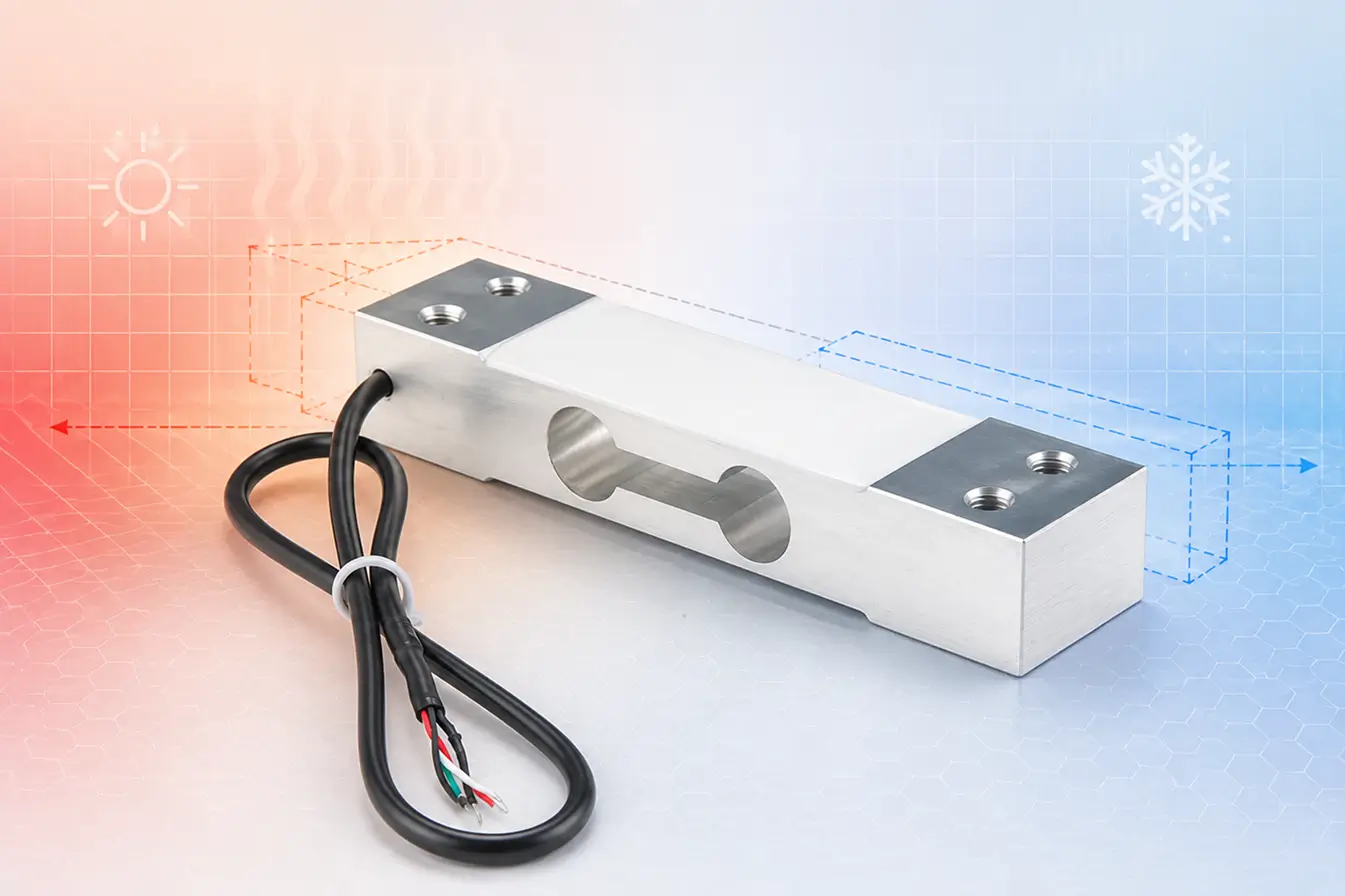
Temperature compensation is the process of reducing the effect of temperature changes on load cell output.
Load cell manufacturers may use several techniques to achieve this.
Every load cell has a specified compensated temperature range and operating temperature range.
These specifications should not be confused.
The compensated temperature range is the temperature range over which the manufacturer has designed the load cell to maintain specified performance characteristics.
The operating temperature range is generally the broader range within which the load cell can function without physical damage, although accuracy may not be guaranteed to the same level across the entire range.
For example, a load cell might be designed to operate from -20°C to +70°C while having a narrower compensated range.
Always check the manufacturer’s datasheet before installing a load cell in an environment with extreme temperatures.
If your application requires very high accuracy, pay close attention to temperature effect specifications such as:
Temperature is often accompanied by other environmental challenges such as moisture, dust, chemicals, and vibration.
For harsh industrial environments, consider load cells with appropriate IP ratings and protective construction.
A stable environment at 50°C may be easier to manage than an environment that repeatedly changes from 10°C to 50°C.
Rapid temperature cycling can introduce additional thermal effects and mechanical stresses.
The temperature at the load cell may differ significantly from the surrounding room temperature.
For example, a load cell installed near:
may experience localized temperatures that are much different from the ambient environment.
Where appropriate, use thermal barriers, insulation, shielding, or suitable mounting arrangements to prevent excessive heat transfer.
However, these measures should be implemented carefully. Improper insulation can sometimes trap heat around the sensor rather than protect it.
In industrial environments, even small measurement errors can have significant consequences.
A temperature-induced error in a batching system could affect the quantity of raw materials being added. In manufacturing, inaccurate force measurements can affect product quality. In testing applications, temperature-related measurement drift can influence test results.
Therefore, load cell selection should consider not only capacity and accuracy, but also the environmental conditions in which the sensor will operate.
Temperature is one of the key environmental parameters that should be evaluated before selecting a load cell.
Temperature can affect load cell performance, zero balance, sensitivity, strain gauge resistance, and overall measurement accuracy. While modern load cells incorporate temperature compensation technologies, selecting the right sensor for the operating environment remains essential.
When choosing a load cell, consider the expected temperature range, accuracy requirements, temperature compensation specifications, environmental protection, installation conditions, and calibration requirements. Proper installation and regular maintenance can further reduce temperature-related measurement errors.
For reliable load cells and industrial measurement solutions, businesses can work with Proact IMS to identify suitable products based on application requirements and operating conditions. Selecting the right load cell from the beginning can help improve measurement reliability, reduce errors, and support consistent industrial performance.