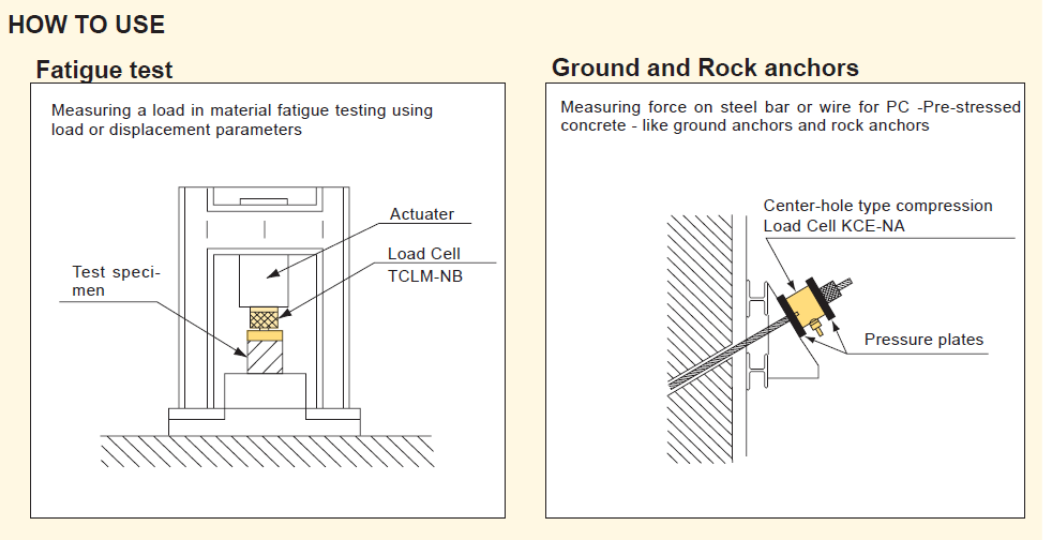
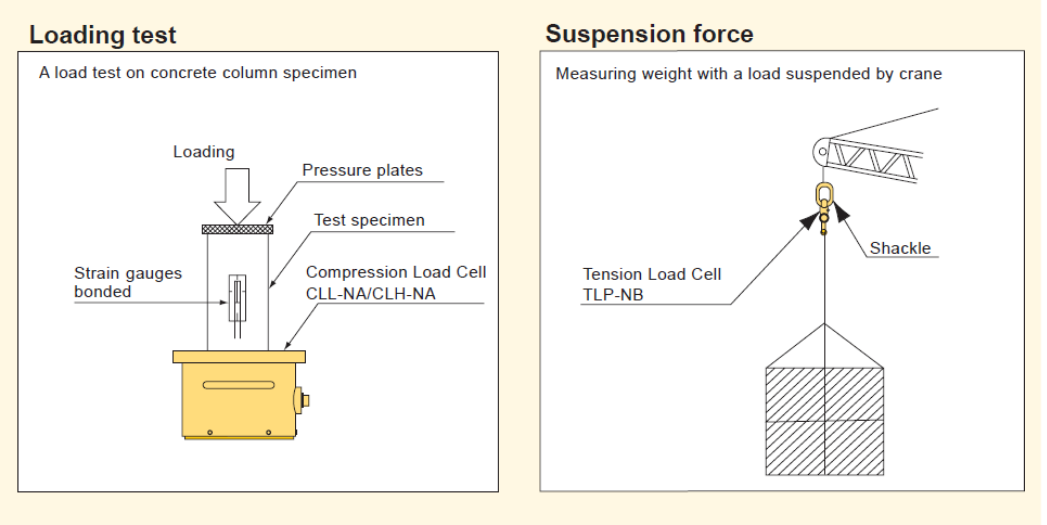
Strain gauge type transducers electrically measure physical quantities such as load and displacement. They operate by converting the physical quantities into mechanical stress, and then detecting that stress with a strain gauge. Proact offers a number of products according to the item and quantity measured. Since our products use strain gauges, they can be connected to all types of measuring instruments for strain gauges, such as Data Loggers and Dynamic Strainmeters, for taking measurements. This enables capabilities like automatic multiple-point measurement as well as measurement via computer. Our strain gauge type transducers offer a variety of features like compact size, light weight and easy operation, high-precision measurements with excellent linearity and consistency, as well as dynamic measurement capability that is
available in many of our products. These features led to widespread use of our strain gauge transducers not only for testing and research, but for control in all types of industrial and civil engineering fields as well. Among these products, transducers recommendable for civil engineering use are guided with the designation.
Key Aspects of Transducers:
- Function: They facilitate the conversion of energy (transduction) for easier measurement, transmission, and processing.
- Types:
- Input Transducers (Sensors): Convert physical, non-electrical parameters into electrical signals (e.g., microphones, thermocouples, strain gauges).
- Output Transducers (Actuators): Convert electrical signals into non-electrical, physical forms (e.g., loudspeakers, motors, lamps).
- Classification:
- Active Transducers: Generate electrical outputs directly (e.g., piezoelectric crystals, thermocouples).
- Passive Transducers: Require an external power source to operate (e.g., LVDT, RTD, strain gauges).
- Components: Typically consist of a sensing element (detects physical change) and a transduction element (converts it).
Transducers are foundational in various industries, including medical imaging (ultrasound probes), industrial automation, and consumer electronics.
Key applications by industry include:
- Automotive & Transportation: Used in MEMS accelerometers for airbag deployment, engine knock detection, fuel pressure monitoring, and brake system regulation.
- Industrial Automation & Manufacturing: Crucial for monitoring pressure in hydraulic systems, controlling robotics through force/position sensors, and ensuring quality control on assembly lines, such as monitoring bolt tightness.
- Medical & Healthcare: Utilized in ultrasound machines for imaging, blood pressure monitors, and acceleromyography for monitoring muscle movement.
- Aerospace & Defence: Employed in measuring altitude, aircraft engine performance, and cabin pressure.
- Energy & Power: Current transducers monitor power in renewable energy systems (solar/wind), while pressure transducers monitor oil and gas pipelines.
- Consumer Electronics: Microphones (sound to electricity) and speakers (electricity to sound), as well as temperature sensors in home appliances.
Common Types and Their Uses:
- Pressure Transducers: Measure fluid, gas, and air pressure in HVAC, hydraulic, and manufacturing systems.
- Temperature Transducers (RTDs / Thermocouples): Used for process control and thermal monitoring.
- Piezoelectric Transducers: Used in non-destructive testing (NDT), vibration monitoring, and medical ultrasound.
- Velocity/Proximity Sensors: Used in robotics for positioning and geophones for seismic surveying.
A Complete Beginner’s Guide for transducer
Transducer terminology
- Capacity: Maximum load that a transducer can measure and still maintain specifications.
- Rated Output (RO): Output at the rated load minus output under no-load conditions. Rated output is expressed per volt applied to the transducer (mV/V).
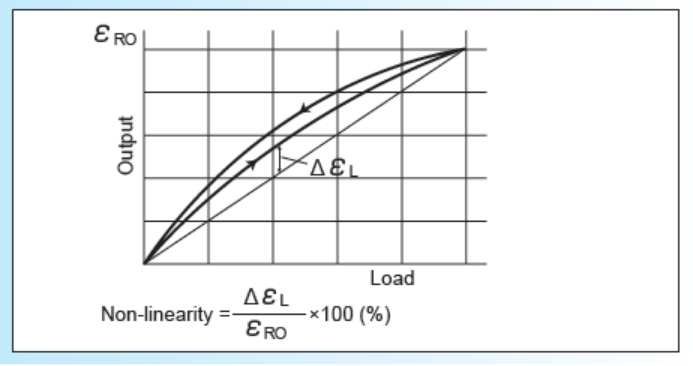
- Non-linearity: Maximum distance of the transducer’s output from a line connecting the calibration curve origin and the rated load point with increasing loads. Non-linearity is expressed as a percentage of rated output (%RO).
- Hysteresis: Maximum difference between transducer output with increasing and decreasing loads. Hysteresis is expressed as a percentage of rated output (%RO).
- Repeatability: Maximum difference in output when the same rated load is measured repeatedly under identical load and environmental conditions. Repeatability is expressed as a percentage of rated output (%RO).
- Temperature effect on zero: Transducer output due to changes in ambient temperature. Temperature effect on zero expresses changes per degree of ambient temperature as a percentage of rated output (%RO/°C).
- Temperature effect on span: Rate of change in rated output due to changes in ambient temperature. Temperature effect on span is expressed per degree of ambient temperature (%/°C).
- Compensated temperature range: Range of temperatures compensated for temperature effect on zero and span (°C).
- Allowable temperature range: Range of temperatures that can be applied continuously without causing permanent destructive change to the transducer (°C).
- Overload: Load that can be applied continuously without causing permanent destructive change exceeding specifications (%).
- Ultimate overload rating: Maximum load that can be applied continuously without causing permanent destructive change mechanically (%).
- Recommended exciting voltage: Voltage that can be applied to the transducer and still maintain specifications (V).
- Allowable exciting voltage: Maximum voltage that can be applied continuously to the transducer without causing permanent destructive damage (V).
- Zero balance: Output strain while unloaded (%RO).
- Frequency response: Maximum frequency at which the transducer can output within a specified range using a sine wave load (Hz).
- Natural frequency: Approximate frequency under no-load conditions at which a transducer oscillates freely (Hz).
- Allowable bending moment: Maximum bending moment that can be applied continuously to the transducer without causing permanent destructive damage (kN·m).
- Sensitivity: Transducer output with a fixed load. Sensitivity expresses strainmeter output per millimetre (microstrain/mm) when the strainmeter coefficient on the displacement transducer is set at 1.000 (2.00-gauge factor fixed).
- Gauge length: Distance between two points used to measure displacement or strain.
- Spring force: Approximate force required to displace capacity on the displacement transducer (N).
- Input/Output resistance: Resistance between input and output terminals measured under no-load conditions with input and output terminals disconnected (Ω).
- Input/Output cable: Cable that cannot be disconnected from the transducer.
- Supplied cable: Standard cable accessory that can be disconnected from the transducer.
- Weight: Approximate weight of the main unit minus I/O cable and cable accessories.
- About IP ratings: A classification system rates how well enclosures and package for electrical components seal against intrusion by foreign materials such as dust and moisture. It conforms to JIS C0920 or IEC 60529 and entails various levels of ingress protection afforded against solid objects and water.
- TEDS support: TEDS is an abbreviation of Transducer Electronic Data Sheet. A TEDS compatible transducer has sensor information conforming to IEEE1451.4 as electronic data inside. It enables automatic input of sensor information including the sensitivity and serial number into the measuring instrument. This automation eliminates wrong settings, significantly reduces the time required for settings and realizes efficient and simple works. For more details of TEDS compatible transducers and measuring instruments, please contact us.