
Table Of Contents
In modern industrial testing, monitoring, and research environments, data acquisition systems (DAQ) are the backbone of every measurement decision. Whether engineers are validating a new aerospace component, monitoring vibration on rotating machinery, or tracking strain on a bridge, the quality of their decisions depends on the quality of the data they collect.
Today, DAQ systems come in two major architectures — wired and wireless — and choosing between them is no longer a simple matter of cost or convenience. The right choice depends on application complexity, environmental conditions, sampling speed, and long-term scalability. At Proact IMS, we help engineers and decision-makers select the right architecture, and that begins with a clear understanding of what each system offers.
A data acquisition system (DAQ) is a combination of hardware and software that captures real-world physical signals — such as strain, force, pressure, temperature, vibration, or displacement — converts them into digital data, and stores or analyses them for engineering use.
A typical DAQ system includes:
The way these elements communicate — through cables or wirelessly — defines whether the system is wired or wireless.
A wired DAQ system uses physical cables to transmit signals between sensors, signal conditioners, and the data logger or controller. Communication typically happens through Ethernet, USB, CAN-bus, RS-485, or proprietary high-speed digital buses.
Wired systems have been the traditional backbone of industrial measurement for decades because of their reliability, high sampling rates, and immunity to wireless interference. They are especially valued in environments where signal integrity, synchronisation, and continuous high-bandwidth recording are non-negotiable.
In a wired DAQ setup, every sensor cable physically routes back to a central acquisition unit — which means installation effort scales with channel count, but signal quality remains uncompromised.
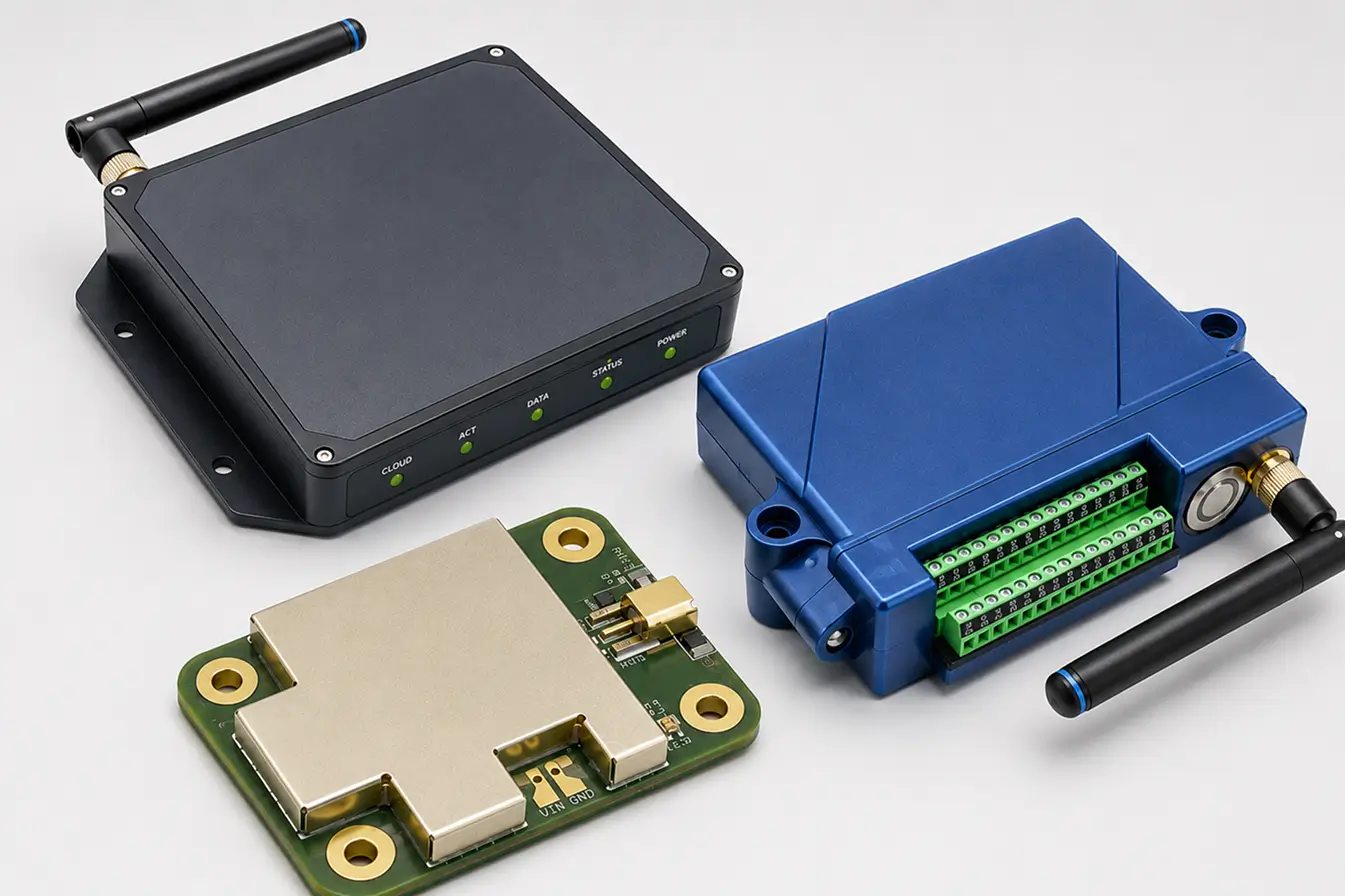
A wireless DAQ system transmits sensor data through radio frequency, Wi-Fi, Bluetooth, LoRa, or proprietary RF protocols, eliminating the need for long signal cables. The sensor or sensor node digitises and transmits data to a base station or directly to a cloud platform.
Wireless DAQ systems have grown rapidly in popularity due to advances in low-power electronics, IoT connectivity, and battery technology. They are particularly valuable in remote monitoring, rotating equipment, large structures, and applications where running cables is expensive, dangerous, or simply impractical.
Modern wireless DAQ systems also offer real-time edge computing, where preliminary analysis happens at the sensor node itself — sending only meaningful data to the central system and reducing bandwidth load.
| Parameter | Wired DAQ | Wireless DAQ |
|---|---|---|
| Signal Quality | Excellent, low noise | Good, depends on RF environment |
| Sampling Rate | Very high (up to MHz range) | Moderate to high (up to kHz range) |
| Channel Synchronisation | Excellent, sub-microsecond | Good, depends on protocol |
| Installation Effort | High (cabling required) | Low (plug-and-play nodes) |
| Mobility / Flexibility | Limited | High |
| Power Source | Mains / DC supply | Battery or harvested energy |
| Environmental Robustness | High, with proper shielding | High, with sealed nodes |
| Scalability | Limited by cabling effort | Highly scalable |
| Maintenance | Periodic cable inspection | Battery replacement, RF tuning |
| Initial Cost | Lower per channel | Higher per channel |
| Long-Term Cost (Large Sites) | Higher (cabling, labour) | Lower |
Understanding when to choose wired or wireless DAQ becomes practically relevant in everyday engineering scenarios:
Aerospace structural testing typically uses wired DAQ systems — fatigue, modal, and ground vibration tests demand sub-microsecond synchronisation and very high sampling rates that only cabled architectures can deliver consistently.
Wind turbine condition monitoring is a classic wireless application — accelerometers and strain gauges mounted on rotating blades or remote nacelles transmit data wirelessly to a centralised SCADA or cloud platform, eliminating slip rings and long cable runs.
Automotive on-vehicle measurement often combines both — a wired DAQ logs high-speed CAN-bus and engine data, while wireless nodes on wheels and suspension components capture rotating-component data without slip rings.
Civil and structural health monitoring of bridges, dams, and buildings increasingly favours wireless DAQ — long cable runs across spans are expensive and vulnerable, whereas wireless sensor nodes powered by solar harvesting can monitor structures for years with minimal maintenance.
Material testing labs rely almost entirely on wired DAQ — the controlled environment, high sampling rates, and need for tight channel synchronisation favour cabled architectures.
Oil and gas remote monitoring benefits from wireless DAQ — remote pipelines, offshore platforms, and hazardous zones are far easier to monitor without running cables, especially when ATEX-certified wireless nodes are used.
In many modern industrial applications, the smartest answer is not “wired or wireless” — it is both. Hybrid DAQ architectures combine wired backbone systems for high-speed, synchronised measurements with wireless nodes for remote, mobile, or distributed channels.
For example:
At Proact IMS, our engineering team designs both standalone and hybrid DAQ systems — integrating the strengths of each architecture to deliver the most reliable, cost-effective, and scalable measurement solution for the application.
Choosing the right strain gauge is not a one-size-fits-all decision. It requires careful consideration of the physical quantity being measured, the material and geometry of the test object, the operating environment, the measurement duration, and the required accuracy. From gauge length and grid material to bridge configuration and adhesive compatibility — every detail matters.
At Proact IMS, our instrumentation specialists have extensive experience specifying, installing, and calibrating strain gauge systems across industries including oil and gas, power generation, heavy manufacturing, and civil infrastructure. Whether you are setting up a one-off stress analysis test or a permanent structural monitoring system, our team ensures you get the measurement solution that fits your application precisely.