
Table Of Contents
Residual stress is an internal stress that remains within a material even after the external force or load that created it has been removed. In aerospace components, residual stress is an important engineering consideration because aircraft and spacecraft structures must withstand repeated loading, vibration, temperature changes, and demanding operating conditions.
Residual stresses can be introduced during manufacturing processes such as machining, welding, heat treatment, forging, casting, shot peening, and additive manufacturing. Depending on their magnitude, direction, and location, these stresses can either improve component performance or contribute to fatigue, distortion, cracking, and premature failure.
Understanding and measuring residual stress is therefore essential for maintaining the reliability, dimensional stability, and structural integrity of aerospace components.
Residual stress is the stress that remains inside a component when there is no externally applied load.
A component can appear unloaded and stationary while still containing significant internal stresses. These stresses develop when different regions of a material undergo unequal plastic deformation, thermal expansion, contraction, or phase changes during manufacturing.
Residual stresses are generally classified as:
Tensile residual stresses can be particularly concerning in components exposed to cyclic loading because they may contribute to crack initiation and propagation. Compressive residual stresses, on the other hand, can sometimes improve fatigue resistance by making crack initiation and growth more difficult.
The effect depends heavily on the component, material, manufacturing process, and stress distribution.
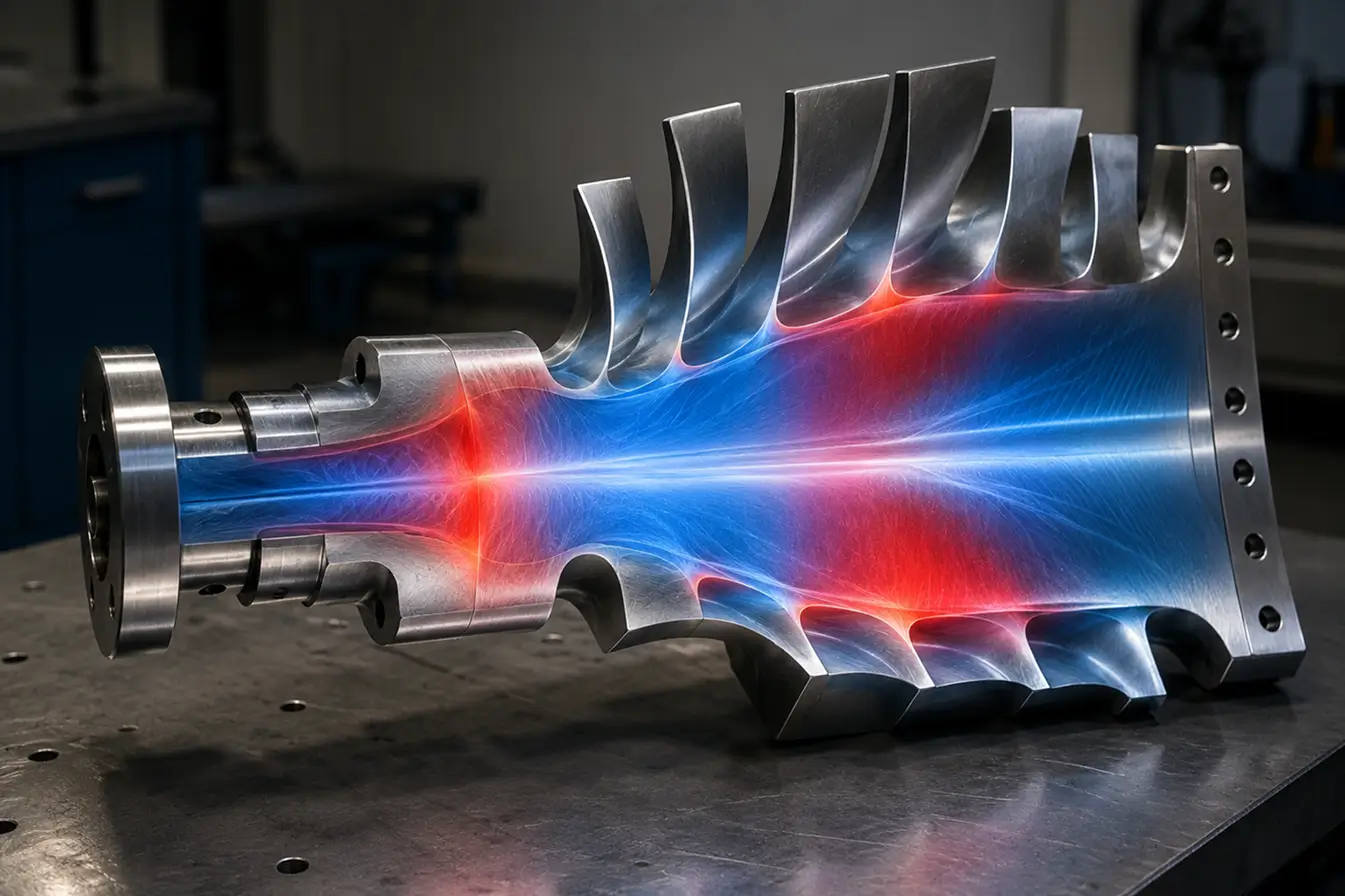
Aerospace components operate under demanding conditions. Aircraft structures and engine components may experience thousands or millions of loading cycles during their service life.
Components can also be exposed to:
Residual stresses can interact with these service loads.
For example, a component containing tensile residual stress may experience a higher effective stress when an external tensile load is applied. This can increase the likelihood of fatigue crack initiation.
Because aerospace components are often designed with strict safety and reliability requirements, understanding residual stress is an important part of quality control and structural integrity assessment.
Machining removes material from a component using cutting tools. The cutting process generates mechanical and thermal effects near the machined surface.
If the material is plastically deformed or heated unevenly during machining, residual stresses can remain after the component returns to its normal temperature.
Factors such as:
can influence the resulting residual stress.
This is particularly important for precision aerospace components where surface integrity and fatigue performance are critical.
Welding produces localized heating followed by cooling.
The welded region expands during heating and contracts as it cools. Because the surrounding material restricts this movement, residual stresses can develop around the weld.
These stresses may contribute to:
Heat treatment is commonly used to modify the mechanical properties of aerospace alloys.
During heating and cooling, different regions of a component can experience different thermal expansion and contraction rates. Phase transformations can also contribute to residual stress formation.
Improperly controlled heat-treatment processes can therefore result in undesirable stress distributions.
Unlike several manufacturing processes that may introduce undesirable tensile stresses, shot peening is intentionally used to introduce compressive residual stress into a component’s surface.
Small shots are propelled against the material surface, causing controlled plastic deformation.
The resulting compressive surface stresses can improve resistance to fatigue crack initiation and propagation.
Shot peening is therefore widely used where improved fatigue performance is required.
Additive manufacturing builds components layer by layer. Each layer may experience localized heating and cooling.
The repeated thermal cycles can create complex residual stress distributions within the finished component.
Residual stresses in additively manufactured aerospace parts can contribute to:
Aerospace components often experience cyclic loading. Residual stresses can alter the effective stress experienced during each cycle.
Tensile residual stresses near a surface can increase the risk of fatigue crack initiation, while compressive residual stresses can improve fatigue resistance under suitable conditions.
Residual stress can influence the driving force for crack propagation.
A tensile residual stress field can promote crack opening, while compressive stress can help suppress crack growth under certain loading conditions.
Residual stresses can cause components to deform when material is removed or when manufacturing constraints are released.
This can be particularly problematic for precision aerospace components where dimensional tolerances are extremely tight.
X-ray diffraction (XRD) is a widely used non-destructive technique for measuring near-surface residual stresses in crystalline materials.
It works by analyzing changes in the crystal lattice caused by stress.
XRD can be useful for evaluating machined, treated, coated, and shot-peened aerospace components.
The hole-drilling method is a semi-destructive technique in which a small hole is carefully introduced into the component.
The resulting strain relaxation is measured and used to calculate residual stress.
It can provide information about residual stress at different depths near the surface.
Neutron diffraction can measure residual stress deeper within a component than many surface-based techniques.
This makes it useful for investigating internal stress distributions in larger or complex aerospace components.
However, neutron-based measurement typically requires specialized facilities and equipment.
Ultrasonic techniques can also be used to evaluate stress-related changes in materials.
Depending on the method and application, ultrasonic testing can provide useful information while offering advantages for certain inspection environments.
Controlling residual stress starts with understanding how it is introduced during manufacturing.
Several approaches can be used.
A complete residual stress evaluation should consider:
Aerospace manufacturing requires high levels of consistency and reliability. Components must meet strict dimensional and mechanical performance requirements throughout their service life.
Residual stress measurement can help manufacturers and engineers:
Residual stress is an important factor in the performance and reliability of aerospace components. It can be introduced through machining, welding, heat treatment, shot peening, additive manufacturing, and other manufacturing processes.
While tensile residual stress can contribute to fatigue and crack growth under certain conditions, compressive residual stress can sometimes improve fatigue resistance. The effect depends on the material, component geometry, stress distribution, and operating conditions.
Accurate residual stress measurement helps aerospace manufacturers understand the actual condition of their components and optimize manufacturing processes for improved reliability and performance.
For aerospace manufacturers and engineering organizations looking for residual stress measurement and material testing solutions, Proact IMS can support the evaluation of components and materials using appropriate measurement and testing approaches. Understanding residual stress at the manufacturing stage can help improve quality, dimensional stability, and long-term component reliability.