


What are residual stresses and how are they caused?
All stresses that exist in materials, also without the application of any external loads, are termed residual stresses. Residual stresses can originally exist in a component and naturally add to stresses induced by applied loads.
As a result, residual stresses influence the behaviour of mechanical components and can impair the structural and dimensional stability, as well as the fatigue and fracture resistance of components. A residual tensile stress actually facilitates crack propagation and therefore reduces the fatigue life of a mechanical component.
Residual stresses limit the loading capacity and safety of mechanical components during operation and in certain circumstances it is necessary to be able to quantify those stresses. In other instances, residual stresses are actually desired. Turbine blades and other metal components are often made with residual stresses to limit cracking and fatigue. In these cases, strong controls and careful calibrations are performed to determine the desired level of stress during the production process.
Residual stresses can be caused by the following main factors:
-
Non-uniform heating or cooling of a component during manufacturing and fabricating processes (casting, welding, molding and heat treatment process)
-
Machining processes to remove shavings or plastic deformation (turning, milling and forging)
-
Through or surface heat treatments (tempering, nitriding and cementation)
-
Surface treatments (shot peening and sand-blasting)
The study and measurement of residual stresses are therefore crucial in mechanical design engineering for preventing failures, and in some cases even disasters.
-
Typical application fields of residual stress
- Aerospace industry (airplane and aerospace applications)
- Automotive industry (series production, sport races and competitions)
- Energy production (steam, wind and nuclear power plants)
- Oil and Gas (compressor and turbine parts)
- Railway production (wheels and railways samples)
- Production control (quality control of the surface and heat treatment)
-
Strain gage methods for residual stress measurement
A strain gage can be used for a great variety of residual stress measurements.
Many methods exist for the measurement of residual stresses in engineering applications. The method used for the residual stress measurements works on the principle of removing material from the component to release stresses: after this operation the stress equilibrium is modified and one or more strain gages, placed in the measurement area, acquire the strain values needed for the new equilibrium of the workpiece.
The strain data acquired by the strain gage sensor are used for the back calculation of residual stresses using special influence functions.
The strain gage residual stress methods are commonly divided in 2 families:
-
Semi destructive methods (Hole drilling method, Ring Core method)
-
Destructive methods (Layer removal, Sach’s and Sectioning methods)
The semi-destructive methods remove just a small quantity of material closer to a strain gage rosette placed in the measurement area, leaving its overall structural integrity intact for other testing or use. This is why these methods (mainly the hole drilling method) are considered semi-destructive. On the contrary, the destructive methods need a higher remotion of material (cuts and milling process) that completely destroy the testing workpieces.
-
-
Each strain gage residual stress method has a particular depth of analysis that can offer a wide range of applications

The hole-drilling method for the measurement of residual stresses:
The hole-drilling method allows accurate experimental stress analyses at moderate costs. It consists in drilling a small hole (typically 1.8 – 2.0 mm) which changes the initial deformation allowing redistribution of the residual stresses locked in a material.
The strains that are released in this way can be measured by a specially configured three-element strain gage rosette and then used in special calculation system to determine the residual stresses that exist in a material.

Briefly summarized, the measurement procedure involves the following steps:
-
A strain gage rosette with three radial grids is installed
-
A through hole or a blind hole is drilled through the geometric centre of the rosette
-
Readings are made of the strains produced by relieving the residual stresses
-
The residual stresses are calculated from the measured strains using special calculation algorithms
The hole drilling residual stress method is regulated by the ASTM E837-13a standard applicable to uniform or not uniform residual stress field in the depth.
With the strength of many years of experience in the field of strain gage measurements, mechanical design engineering and software development, SINT Technology has developed and patented a fully automated system for measuring residual stresses.
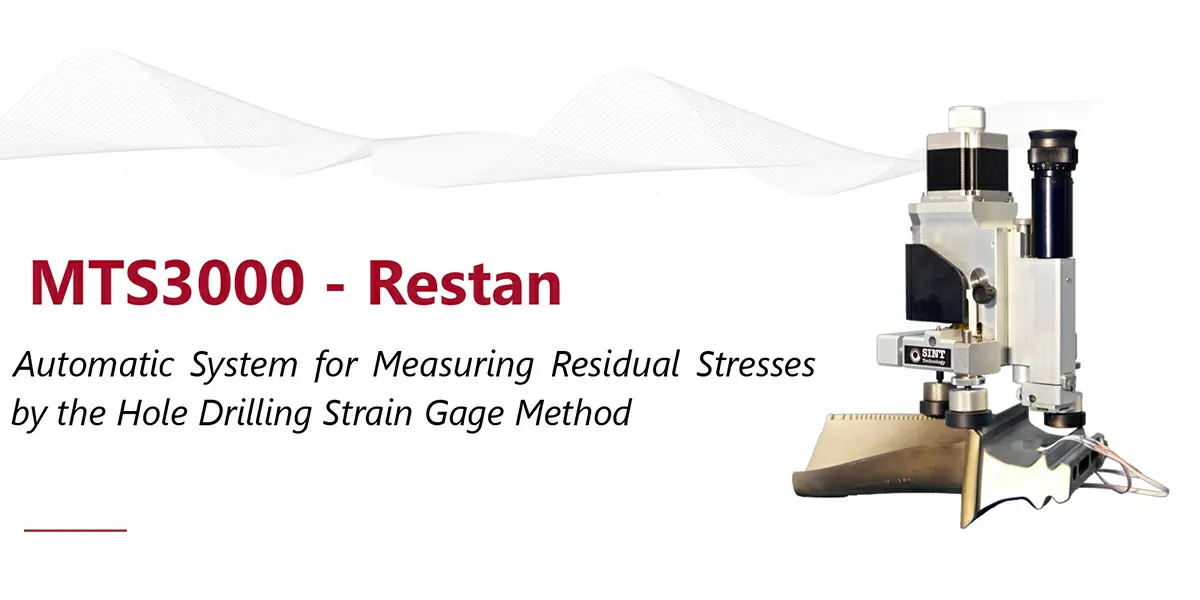
Proact IMS uses its SINT system, the MTS3000, also known as RESTAN (Residual Stress Analyzer), which allows residual stresses to be measured by the hole-drilling method and the data acquired by that technique to be processed by five possible calculation systems:
-
The ASTM E837-13a Standard Test Method for uniform stresses
-
The ASTM E837-13a Standard Test Method for non-uniform stresses
-
The Integral Method
-
The Schwarz-Kockelmann Method
-
HDM method
Consequently, the system provides a complete analysis of relieved strain distribution and of near-surface residual stress profiles on completion of testing
-


